
Reading the ground before we draw anything
Ground around here is rarely one thing. A single Marietta yard can have clay-heavy soil in one spot, sandier soil in another, and slopes or worn, eroded patches that don't show from the kitchen window. We walk your lot before we stake anything rather than assume it is level and uniform.
On that walk we note which way the yard slopes, any spots where rain has carried soil off, and which patches feel soft underfoot. Those answers decide where the patio sits, how much prep the ground needs, and which side gets the fall. A patio pushed into the most convenient corner without that look is the one most likely to settle unevenly.
Where the water goes
Much of the soil here has a clay-rich subsoil, and rain runs off it at a medium-to-rapid clip instead of soaking in. A patio is a hard, flat obstacle in that water's path. Left unplanned, the water either collects against the house or finds a low joint and starts undermining the edge.
We set the surface drainage around your actual slope: which way the paving falls and where the water leaves. Sometimes the right answer is to shift the footprint a few feet or change its shape, and we would rather tell you that at the staking stage than after the pavers are down.
Built for wet years and dry ones
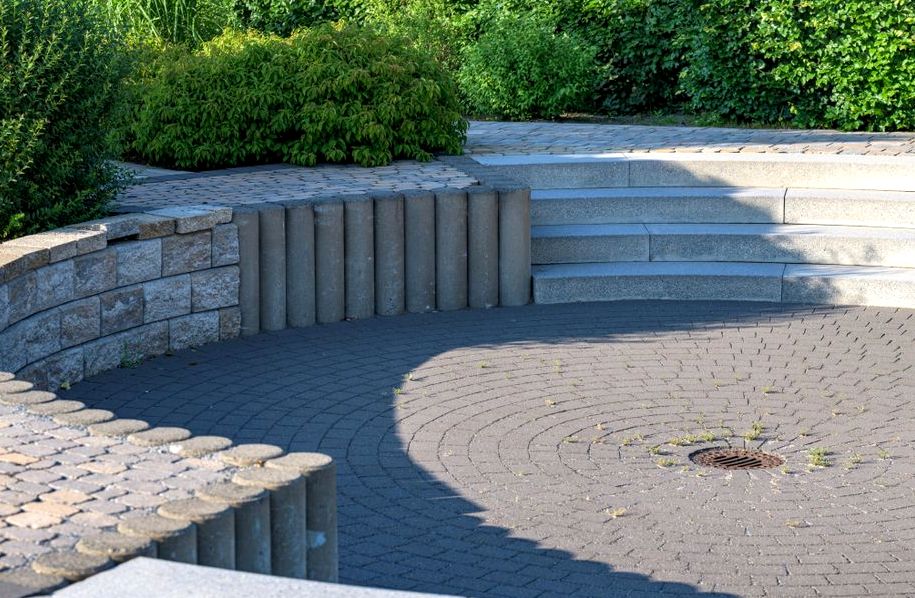
Rainfall here swings from year to year, so the ground under a patio is firm in a dry stretch and soft in a wet one. The edge restraints and the jointing sand do most of the work of keeping the paving steady through both. The restraints stop the perimeter from spreading when the ground moves. Polymeric jointing sand locks the pavers together and keeps the joints from washing out when a hard rain runs across the surface.
How we cut, edge and finish
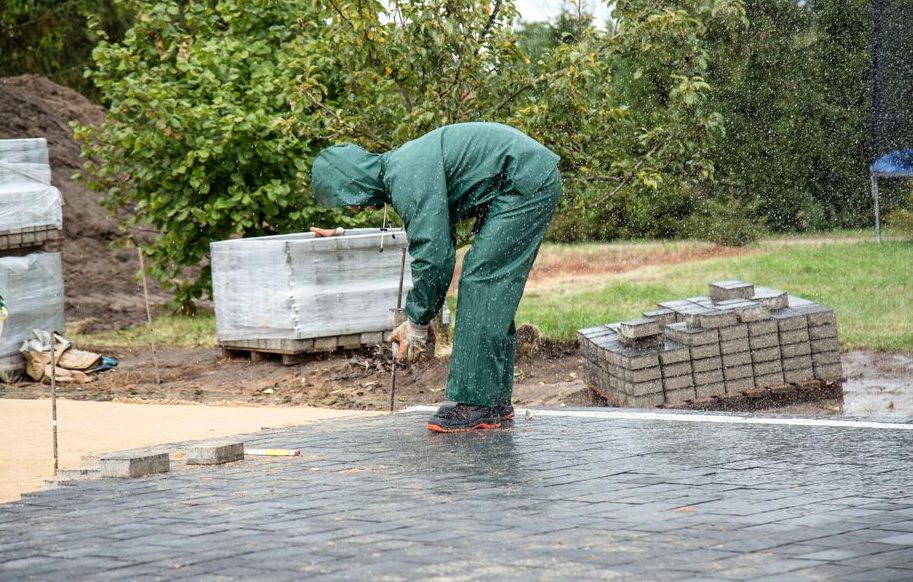
We cut pavers to fit edges and obstacles with a wet masonry saw, wearing protective equipment. Cutting wet keeps the dust down and leaves a clean edge that sits tight against a wall, a downspout or a curve.
We secure the perimeter with plastic edge restraints held by 12-inch spikes, then compact the pavers with a protective pad so they seat without chipping. The last step is sweeping in the polymeric jointing sand.
What drives the price
Natural-stone paver material costs $15 to $50 per square foot, and the stone you choose accounts for most of that gap. That figure is material only, not labor, prep or cutting.
Beyond the stone, the total moves with the size of the patio, the number of cuts around corners, curves and obstacles, how much work a sloped, eroded or soft patch needs before the first paver goes down, and what it takes to move water off your lot. On the call we'll quote a typical range for your patio; the exact number is confirmed once we've seen the yard, and each of those items gets its own line on the written quote. The schedule depends on the same things plus weather, and we set it once we have walked the lot.
Patio or deck
A patio fits when the space is at ground level and you want a durable surface with no framing under it, especially where there is water standing where you'd like to sit or no flat spot for a table. A deck fits better where the yard drops away from the house or you want the surface at door height. Which one your lot allows is what we check on the first visit.
Common Questions
Both retailers offer deck design services and can connect customers with local contractors for installation. They do not typically perform the work directly. Expect design help in-store or online, followed by contractor bids. Confirm details and warranties with the chosen builder before signing.
Related Services
What to Expect
Spelled out, the steps run roughly like this:
- Mark the patio area and arrange to have underground utilities located before excavation.
- Excavate the patio footprint, extending the excavation at least 6 inches beyond the paver edges for edge restraints.
What It Typically Costs
These ranges are a starting point for planning, and the details of your job set the actual number.
$8–$25 per sq ft
$4–$30 per sq ft
Call (470) 742-0070 with whatever details you have, and there's no obligation.